Binomial:
Calendula officinalis
Common names:
Jin Zhan Ju, pot marigold, common marigold, Calypso orange, Scotch marigold, (marybud, gold-bloom, Summer’s bride, husbandman’s dial, holigold, Bride of the sun, spousa solis, golds, the sun’s gold, ball’s eyes, bees-love, oculis-christi, drunkard, marigold, mary gowles, ruddles, solis sponsa, solsequia, English marigold
Family:
Asteraceae
Parts used:
Flowers, single petals (florets)
Native to:
Southern Europe, Egypt, the Mediterranean, Iran [4] [16].
Distribution:
Worldwide [16].
Botanical description:
A daisy-like annual that grows between 0.1 m – 0.5 m high [1].Pale green, simple oblong leaves which may be slightly toothed alternate along the stems. Leaves are aromatic. Stalks are multi-branched.
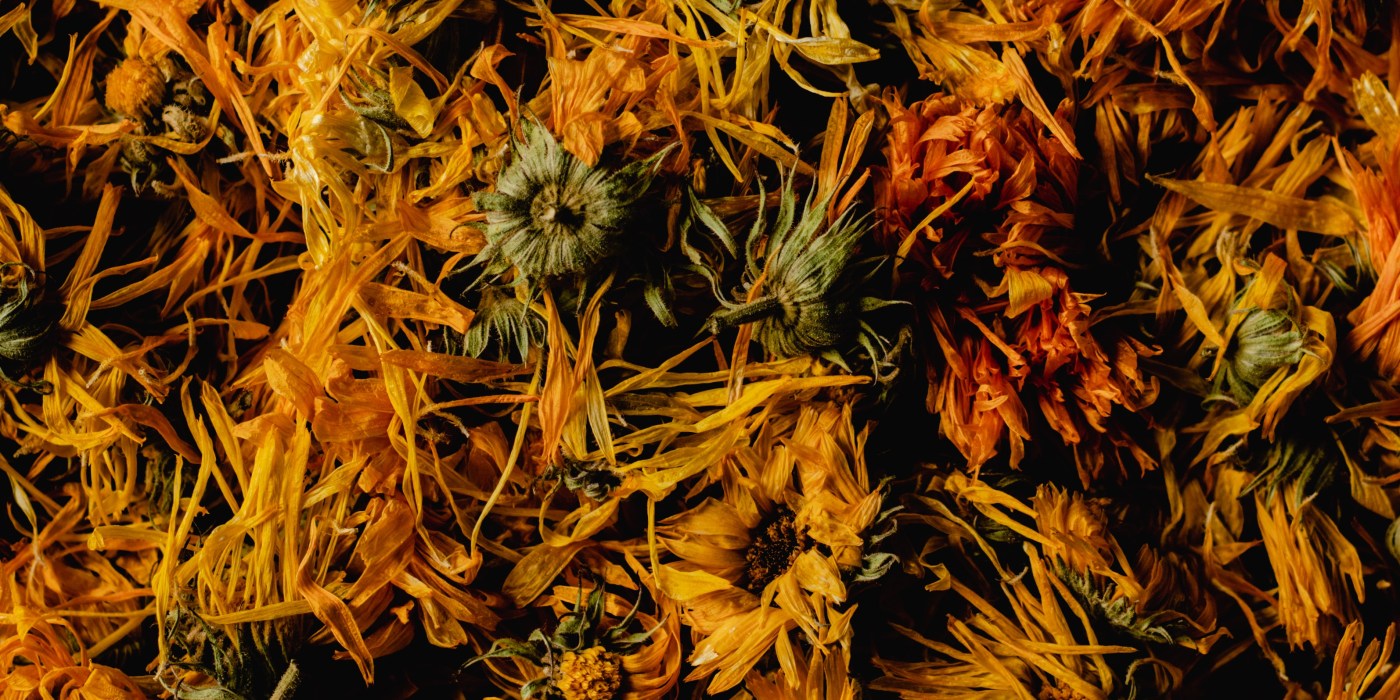
Composite flowers with orange/yellow petals. The flower head has tubular disk flowers in the centre and ray flowers (miniature flowers in and of themselves) outside which are often strap shaped. Flower heads grow between 40 mm to 100 mm [5].
Heads are slightly sticky to touch due to the high concentrations of resins present. Flowers follow the sun, taking in all the energy it has to offer throughout the day.
In a mild climate, calendula blooms throughout the year [1]. Calendula officinalis is suitable for growing in zones 2 to 11 (but opinions on this do appear to differ) [6], requiring fairly consistent levels of sun throughout the day but they don’t grow well in too much heat/drought conditions. As plants grow, you can pinch them back to encourage bushier growth [7].
Minimal care is needed to grow Calendula as it is able to grow in a variety of earth and temperature conditions; though a full sun position is preferred it can tolerate partial shade if necessary. It is also a self-seeder, ensuring its endurance once planted.
Harvesting:
Flowers bloom from spring to autumn and continue to grow for as long as you pick them during this time. Make sure to deadhead any flowers that go unused to ensure regrowth throughout the season. Some report flowers get smaller with each harvest [5] where others report that the size remains fairly consistent (this may have to do with the growing conditions i.e., temperature, etc). Whole flowerheads are often used in place of removing florets, most often due to the time involved in completing the process, but also because the most resins, and therefore medicinal content, are present at the green base (involucres) of the flower head [8].
It’s typically best to dry the flowers before using them in tinctures or infusions as they’re considered “too watery” otherwise [20]. This is best done, by laying them out in a single layer, out of direct sunlight. Use of a higher percentage alcohol than is typically available in the UK would be required to counter the higher water content of a fresh tincture. High water content in combination with other factors, such as storage temperature, risk tinctures becoming contaminated with botulism [21].
History and other traditions:
The root of its name is believed to be due to the fact it’s known to flower throughout the “calends of every month”.
Calendula is an extremely common herbal medicine; it’s use spanning back at least as far back to the Ancient Egyptians where it had cosmetic use to rejuvenate a person’s skin [11]. There has been a somewhat disputed history but it has held great importance to the Europeans and early American colonists for several centuries as a food and as a medicine.
A host of magical properties have been attributed to Calendula over the ages, including protective qualities and the power of prophecy. It has also been posited that it was the first flower to be used in the “he loves, he loves me not” game.
It was most frequently used to flavour stews, soups and other one-pot meals historically but It was also used to add colour to butter and cheeses and more widely, as a natural dye.
Medicinal summary:
Calendula is a modest little herb, with use stemming right back to the Ancients. It has benefits across the body but it is most commonly known for its benefits on the skin – from eczema to nappy rash, psoriasis to sore nipples and even the intestinal lining and stomach. It is a great aid in healing wounds and can be used freshly plucked for injuries acquired “in the field”.
Mild and gentle herbs are at risk of being overlooked but it is that gentleness, along with it’s wide-ranging potential, that I feel really makes Calendula such a wonderful herb to work with day to day.
Energetically, it is known for moving in times of stagnation.
It is a fantastic herb for the digestion, from instigating the digestive juices when used as a bitter to helping to heal the intestinal lining.
As a lymphatic, immune tonic and diaphoretic, it is beneficial in illnesses such as colds and flu. Research suggests that the flavonoids and polysaccharides present in Calendula may be responsible for its actions against cold and flu as due to their having antimicrobial and anti-catarrhal effects.
Calendulas antifungal properties suggest it is even helpful support with the likes of vaginal and oral thrush, conditions caused by fungal yeast imbalance.
Its mild astringency which makes it so helpful in healing wounds, also adds to its benefits as a mouthwash.
A very safe herb for most, it is even considered delicate enough to be used externally on infants, though care should be taken with those who may have an allergy to members of the Asteraceae family.
Emotionally, calendula is often used to lift the spirits, due to its resemblance to sunshine [8]. It can be used in formulation with herbs such as St. John’s Wort for this purpose.
In Ayurveda, Calendula is used to balance Pitta, reducing Kapha and increasing Vata. It’s used for those exhibiting a lot of moisture and heat (i.e. fevers, hot flushes, night sweats, phlegm, tongue swelling and an unproductive cough) [12]. In TCM, Calendula is used to tonify the Blood, Liver and Yin. As in Ayurveda, it works to dry excessive moisture.
Constituents:
- Amino acids [21]
- Bitters (loliolide) [2] [18] [20]
- Carotenoids (carotene, calendulin) [2] [18] [21]
- Chlorogenic acid [17]
- Coumarins (scopoletin, umbelliferone, esculetin) [21]
- Fatty acids [2] [21]
- Flavonoids (isoquercitrin, narcissin, rutin) [2] [3] [17] [18] [20] [21]
Antioxidant - Minerals (iodine, iron, manganese, zinc, copper, nitrogen, chromium, potassium, calcium) [20] [21] [32]
- Mucilage [2] [3] [18]
- Pentacyclic alcohols [18]
- Phenols [21]
Antioxidant - Phytosterols [18]
- Polysaccharides [2] [18] [20]
- Quinones (plastoquinone, phylloquinone, a-tocopherol, ubiquinone) [21]
Antioxidant - Terpenoids [21]
- Triterpene glycosides (calendulosides A-D) [3] [17] [18]
- Salicylic acid [3]
- Saponins [2] [3] [18] [21]
- Sesquiterpene glycosides [18]
- Sterols [2] [21]
- Resins [2] [3] [18] [20]
- Tannins [21]
- Volatile oils [2] [3] [17] [18] [20]
- Antibacterial
Actions:
- Alterative [13]
- Antibacterial [16] [18]
- Antifungal [2] [13] [16] [17] [18]
Though Dr Maria Marciano notes this action is only evident in tinctures of 90% alcohol due to it’s antifungal action is found in the resin which can only be broken down effectively by high high-proof alcohol. [10] - Anti-inflammatory [2] [13] [16] [17] [18]
- Anti-haemorrhage [18]
- Antihistamine [18]
- Antimicrobial [2] [13] [27]
- Antiprotozoal [18]
- Antiseptic [18]
- Antispasmodic [2] [17] [18]
- Antiviral (though argued it is more a bacteriostatic by The Practical Herbalist) [12] [16]
- Astringent [15] [17]
- Cholagogue [17]
- Diaphoretic [18]
- Demulcent [2]
- Emmenagogue (mild) [2] [13] [17]
- Emollient [2]
- Haemostatic [18]
- Immune tonic [2] [10] [18]
Mildly supportive of the immune system unlike the more direct immunostimulant action found in Echinacea. It builds up over time and helps keep elimination pathways clear. - Lymphatic (mild) [2] [13] [17]
- Styptic [18]
- Vulnerary [2] [15]
Energetics:
- Cooling [15]
- Constricting [15]
- Both drying and moistening [15] [20]
- Moving
- Soothing
- Warming (primarily) [18]
Taste:
- Astringent (mild) [20]
- Bitter (mild) [20]
- Pungent
- Resinous [20]
- Salty [20]
- Sweet [20]
Preparations:
- Compress
- Freshly crushed and used topically
- Infusion
- Liniment
- Lotion/salve
- Oil
- Poultice
- Tincture
- Vinegar
Recipes:
- “Gut heal tea” [19].
- Herbal mouthwash for gingivitis (with ginger & rosemary) [28].
- Combine with anise to thin mucous.
- Pairs well with black tea for additional astringency [12].
- Calendula salve.
Safety:
- Avoid internal use in pregnancy as it is has emmenagogue action and can induce contractions [15].
- Generally regarded as safe, even for use on children (topically).
- Possible allergen to those with known allergies to the Asteraceae family [3][13][17].
Dose:
- Tincture (dry): 1 ml – 4 ml 3 x a day (1:5 in 60%) [17]
- Infusion: 1 tsp – 2 tsp per cup up to 3 x/day [15] [17]
Infusions are steeped for much longer than traditional black tea in order to draw out the medicinal properties. 15 minutes should be the minimum when steeping Calendula but I often steep for nearer to half an hour. Steeping for longer enhances the bitter flavour of Calendula so if including in digestive formulas this is worth consideration. - Externally: Lotion, salve or ointment applied as needed [17]
- Poultice: Applied as needed.
Uses:
Digestion
Calendula is a wonderful digestive herb.Its bitter constituents activate the liver and aid in digestion of fats. “Bitters have a downward baring mechanism, meaning that they bring the vital force down and out. This typically results in fluids being drained from the body, which ultimately leads to a constitutional net drying effect” [9] [20]. It helps support gallbladder issues (where bile is stored) and can be a soothing addition for those suffering from indigestion [20].
As a known wound healer, Calendula works well in this role even internally for GI inflammation, including that common in Chrohn’s, gastritis and colitis [15]. Its demulcent qualities can be seen in its soothing action on the intestinal mucosa which makes it extremely beneficial in cases of leaky gut and food intolerances [20].
Children
Calendula is perhaps most widely known (at least in the UK) as a mild but powerful herb whose which can be used effectively and safely with children. It is considered mild enough to be used topically on babies and infants (i.e. as an ointment on nappy rash [16] [29]).
Wounds
A range of actions found within Calendula make it a powerhouse for wound care and healing. From vulnerary and styptic actions to antimicrobial and astringent, Calendula can be used effectively to clean an injury, staunch blood flow and aid in healing with minimal scarring.
Used topically Calendula speeds tissue healing after injuries of varying severity [15], making it a great first aid herb. It’s beneficial for slow-healing wounds and skin ulcers as well as minor burns and scalds when used topically as an infusion which has been allowed to cool [13] [18] [21].
Calendula also helps keep wounds from hardening and causing scars when applied topically as an infused oil, lotion or salve [20] [25]. It can aid in caesarean wound healing when used externally as an infused oil, lotion or salve [26] and I have even used it topically on my tattoo in place of the more chemical-heavy creams you can buy on the market, with great effect.
Not only useful topically for children, Calendula can be a great aid to nursing mothers too. Used externally on sore nipples as an infused oil, lotion or salve [18] it can bring great relief and aid in the healing process. Make sure to clean off all traces before the next feeding.
As mentioned previously, Calendula can also be used internally for its wound healing qualities, helping to repair internal tissue, such as in the intestines.
Skin
Calendula’s antimicrobial, anti-inflammatory and demulcent actions are undoubtedly what make it so useful when used externally for eczema, dry skin and haemorrhoids [13] [16] [18].
Though its use internally also has some part to play in its positive effects on the skin. The skin is an outward reflection of what goes on internally and so by healing some of what ails us internally, can greatly affect such issues as eczema, acne and psoriasis. Calendula works internally to encourage lymphatic flow – brightening the skin [13]. It also helps clear toxins (via the lymph and a healthy liver which is supported via Calendulas bitter action), helping with eczema, psoriasis, acne and cellulite [13]. Used internally, Calendula can also support those with jaundice [18]. Jaundice is caused by a build-up of a substance called bilirubin which is excreted via your liver, gallbladder and digestive tract. Lowers high enzyme count from damaged liver [20].
Illness
With its antiviral, anti-inflammatory and demulcent actions, Calendula can be used internally to help ease infection and swollen glands [13] [18] [20].
A traditional immune tonic [20] [33], Calendula works gently on the system, building “up the vital heat of the body, maintains balance in the fluid metabolism by clearing any stagnation, keeps the channels of elimination open and detoxifying, and helps keep any pathogenic bacteria at bay.” [9]
Due to its diaphoretic action, Calendula promotes sweating [20] which can be greatly beneficial in cases of flu and fever.
Reproductive organs
In Europe Calendula has been of traditional use as an emmenagogue when utilised as an infusion. As an emmenagogue Calendula can be beneficial with menstrual stagnation. Whereas its antihemorrhagic activity can be beneficial in easing heavy bleeding and its antispasmodic activity in easing cramping [18] [20].
Wood and Richardson both note Calendulas use for menstrual problems. They note its ability to “increase[s] the lifeforce of the pelvic region” and its downward energy.
Calendula has also been touted as beneficial in ointment form for vaginal thrush due to its antifungal and antiviral properties, though these actions may be better attained from a high-proof tincture as noted by Dr Marisa Marciano rather than an ointment [10] [13] [18] [30].
Food
Calendula has a long history as a culinary herb. From its start as a nutritional addition to traditional one pot meals, flowers can also be eaten fresh (i.e. in salads) [13]. It can be added to cauliflower cheese, milky pudding, porridge [16] or baked into focaccia. I most often add Calendula to bone broth for its digestive properties as well as flavour [19].
Miscellaneous
Calendula has a significant amount of formal research conducted around it and continues to do so. One recent animal study in Taipei shows positive results for antifatigue activity [31].
References:
Websites
- The Royal Horticultural Society: www.rhs.org.uk
- The Naturopathic Herbalist: www.thenaturopathicherbalist.com
- The Herbarium – Herbal Academy: https://herbarium.theherbalacademy.com/
- Mountain Rose Herbs: https://mountainroseherbs.com/north-american-calendula
- Native Plant Trust: https://gobotany.nativeplanttrust.org/species/calendula/officinalis/
- Plants for a Future: https://pfaf.org/user/Plant.aspx?LatinName=Calendula+officinalis
- North Carolina Plant Toolbox: https://plants.ces.ncsu.edu/plants/calendula-officinalis/
- Chestnut Herbs: https://chestnutherbs.com/calendula-sunshine-incarnate-an-edible-and-medicinal-flower/
- Herb Rally: https://www.herbrally.com/monographs/calendula-sp
- Evolutionary Herbalism: https://www.evolutionaryherbalism.com/wp-content/uploads/2016/03/Calendula-Calendula-officinalis.pdf
- The Practical Herbalist – Magical uses: https://thepracticalherbalist.com/advanced-herbalism/calendula-myth-and-magic/
- The Practical Herbalist – Energestics: https://thepracticalherbalist.com/advanced-herbalism/calendula-properties-energetics-uses/
Books
13. Chown, V. and Walker, K. 2017. The Handmade Apothecary. London:Kyle Books.
14. Codekas, C. 2018. Healing Herbal Infusions. Salem:Page Street Publishing.
15. Easley, T. and Horne, S. 2016. The Modern Herbal Dispensatory. Berkeley:North Atlantic Books.
16. Fowler, A. 2019. A Modern Herbal. London:Michael Joseph.
17. Hoffman, D. 2003. Medical Herbalism. Rochester:Healing Arts Press.
18. Richardson, N. 2020. Your Period Handbook. London:Aeon.
19. Swift, K and Midura, R. 2018. Herbal Medicine for Beginners. Texas:Althea Press.
20. Wood, M. 2008. The Earthwise Herbal: Volume 1. Berkeley:North Atlantic Books.
Journals/Articles
21. Al-Snafi, A. 2015. The chemical constituents and pharmacological effects of Calendula officinalis – A Review. In: Indian Journal of Pharmaceutical Science & Research. 5.172-185.
22. Daifas, D.P., Smith, J.P., Blanchfield, B., Sanders, G., Austin, J.W. 2003. Effect of ethanol on the growth of Clostridium botulinum. In: Journal of Food Protection. 66(4):610-7.
23. Buzzi, M., de Freitas, F., de Barros Winter, M. 2016. Therapeutic effectiveness of a Calendula officinalis extract in venous leg ulcer healing. In: Journal of Wound Care. 25(12):732-739.
24. Givol, O., Kornhaber, R., Visentin, D., Cleary, M., Haik, J., Harats, M. 2019. A systematic review of Calendula officinalis extract for wound healing. In: Wound Repair and Regeneration.27(5):548-561.
25. Jahdi, F., Khabbaz, A.H., Kashian, M., Taghizadeh, M., Haghani, H. 2018. The impact of Calendula ointment on cesarean wound healing: A randomized controlled clinical trial. In: Journal of Family Medical Primary Care. 7(5):893-897.
26. Jyotisree, G., et al. 2020. Calendula officinalis and Echunacae purpurae as antimicrobial agent. In: Journal of Applied Pharmaceutical Research. 8(2):8-12.
27. Mahyari, S., Mahyari, B., Emami, S. A., et al. 2016. EValuation of the efficacy of a polyherbal mouthwash containing Zingiber officinale, Rosmarinus officinalis and Calendula officinalis extracts in patients with gingivitis: A randomized double-blind placebo-controlled trial. In: Complimentary Therapies in Clinical Practice. 22:93-98.
28. Sharifi-Heris, Z., Farahani, L. A., Haghani, H., Abdoli-Oskouee, S., Hasanpoor-Azghady, S. B. 2018. Comparison of the effects of topical application of olive ad Calendula ointments on children’s diaper dermatitis: A triple-blind randomized clinical trial. In: Dermatology and Therapy. 31(6):e12731.
29. Saffari, E., Mohammad-Alizadeh-Charandabi, S., Adibpour,M., Mirghaffourvand, M., Javadzadeh, Y. 2017.Comparing the effects of Calendula officinalis and clotrimazole on vaginal Candidasis: A randomized controlled trial. In: Women’s Health Journal. 57(10):1145-1160.
30. Tung, Y. T., Wu, M. F., Lee, M. C., Wu, J. H., Huang, C. C. and Huang, W. C. 2019. Antifatigue activity and exercise performance of phenolic-rich extracts from Calednula officinalis, Ribes nigrum and Vaccinium myrtillus. In: Nutrients. 11:1715.
31. Rafiee, H., Mehrafarin, A., Labbafi, M., Qaderi, A. and Naghdi Badi, H. 2015. Mineral elements and biochemical analysis of Calendula officinalis L. affected by biostimulators. In: Trakia Journal of Sciences. 1:27-35.
 Herbal She Wrote
Leave a comment