
Binomial:
Nepeta cataria
Common names:
Cat mint, catnep, cat(s)wort
Family:
Lamiaceae
Parts used:
Aerial parts
Native to:
Europe and most of Asia
Distribution:
Worldwide
Botanical description:
A hardy perennial; catnip grows 1 ft – 3ft tall.
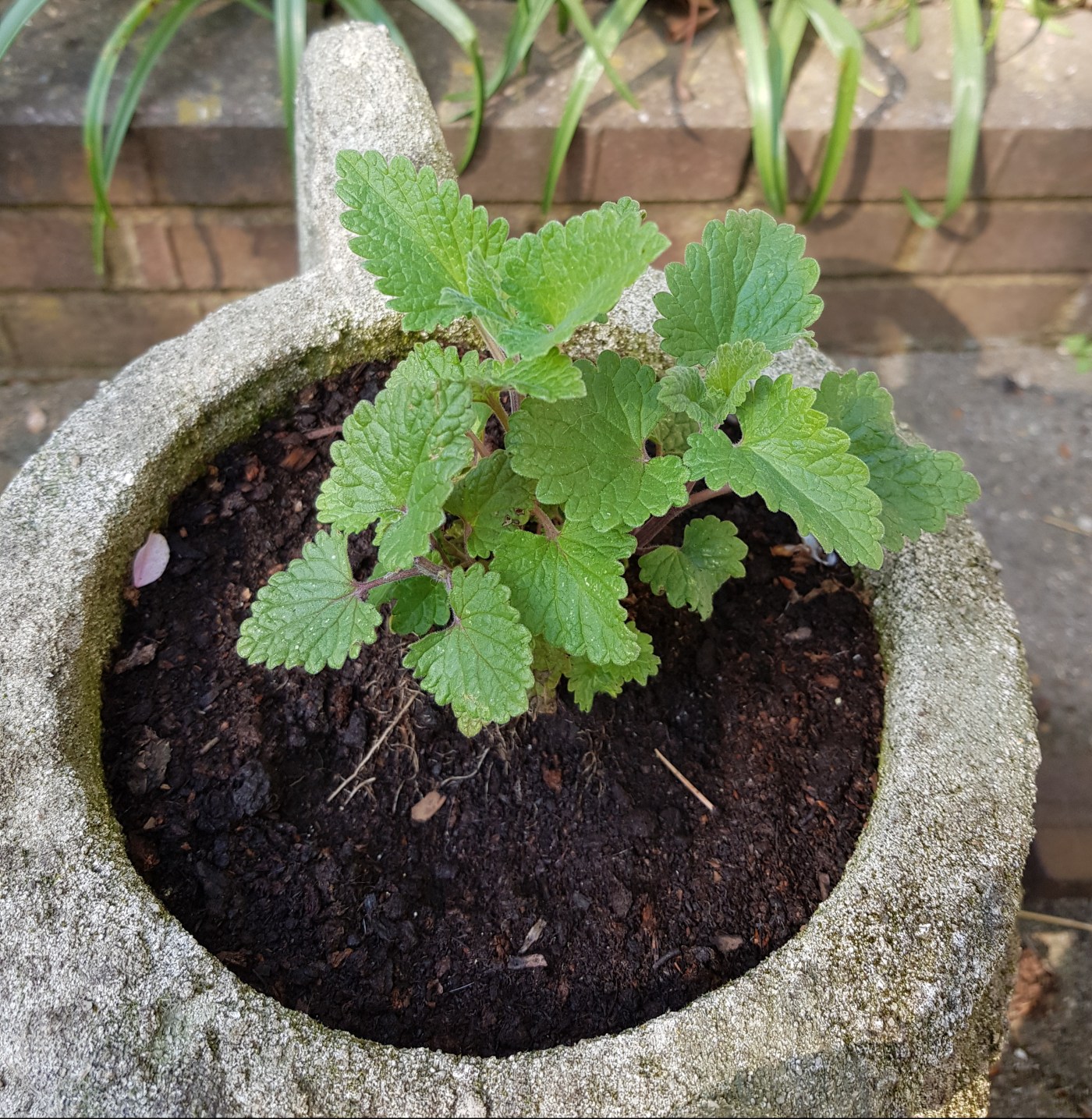
As with others of the mint family, it’s stem is square, growing erect with branched opposing stems. A down covers stems, branches and leaves, where it is lighter and denser on the underside. The leaves are heart-shaped or ovate with serrated margins. Though stem, branches and leaves are a deep green, the down gives them a light greyish twinge.
The flowers are tubular purplish-white and small. They form in dense whorls, more tightly formed at the tip, almost forming a spike. Flowers are hermaphrodite, pollinated by bees and typically bloom between July and October [4].
Catnip appears to grow best in poor quality but well-draining soils, such as on dry banks and in wasteland and prefers full sun. Sandy, loamy soils are ideal. If cultivating, pH 5 – 7.5 is preferred [4].
Harvesting:
Gather aerial parts before flowering and use fresh in infusions, as poultices or to make glycerite [9]. However, the flowers themselves do make a tasty addition to salads or when grazing in the garden. Dried herb loses properties such as the volatile oils so fresh leaf is preferred.
History and other traditions:
Most notably famed for the attraction it holds to cats, there is an old, uncredited saying of catnip:
“If you set it, the cats will eat it,
If you sow it, the cats don’t know it”.
Implying that our feline friends will not bother themselves with catnip that has been started as fresh seed but will go wild for transplanted plants.
Throughout history, before the popularity and shipping of black tea, catnip was regularly infused and drank, being how it grew so well and wild across the UK and was readily accessible to all [7].
One tale tells of a hangman who chewed it before undertaking his job, being unable to otherwise work up his courage to do so [7]. This may relate to stories that the root, when chewed, being able to make even the meekest of people fierce and quarrelsome.
It is said that rats abhor catnip and will go out of this way to avoid it, but whether or not this is due to the plant itself or the fact that you are likely to find cats where you find catnip, seems to be unknown.
Medicinal summary:
Far from stuffing just used to entertain our feline friends, catnip is a powerful yet gentle herb, benefitting young children and adults alike. Its gentle relief often sees it consigned to being considered merely a children’s herb, for which it is indeed considered a wonderful form of first aid, but so often I take comfort from catnip for a variety of ailments myself and would recommend it for use in adults before many seemingly stronger herbs.
Soothing to the digestive system, catnip is a great asset when taken before or after meals. A gentle stimulant digestion when taken prior to meals due to its mildly bitter properties, it can also relieve heartburn, indigestion and flatulence that are common after meals due to its carminative and antispasmodic actions.
Another long-known use of catnip is in conjunction with elderflower and yarrow in cases of colds and flu, where it can help to lessen a fever without directly affecting the body’s temperature itself.
Emotionally, I consider catnip a close ally, feeling it uplifting when moods are low.
Constituents:
- Nepetalactone, a simple iridoid which has sedative action [8]
- Tannins [8]
- Volatile oils (carvacrol, citronellal, nerol, geraniol, pulegone, thymol, nepatali acid) [8] [9]
Actions:
- Antispasmodic [3] [7] [8] [9]
- Bitter (mild)
- Carminative [7] [8]
- Diaphoretic [3] [6] [7] [8] [9]
- Emmenagogue (slightly) [7]
- Hepatoprotective [12]
- Nervine [6] [8]
- Sedative (mild) [6] [8]
- Stimulating (mild) [7]
- Tonic [7]
Energy:
- Neutral temperature (a common phenomenon in the mint family) [3]
- Stimulating [9]
Taste:
- Acrid [9]
- Bitter (mild)
- Cooling [3] [6] [9] and warming [8]
- Moistening [9] and drying [3] [6]
- Pungent [9]
Preparations:
- Tea [8] [9]
- Tincture [6]
- Poultice [8] [9]
- Glycerite [9]
- Leaves and flowers can be eaten freshly picked
Recipes:
- Pair with passionflower or wood betony to aid with sleep disturbances [3].
- Blends well with yarrow and elderflower to break a fever [3] [6].
- Fresh leaf tincture is a strong GI antispasmodic [6].
- Fresh leaf glycerite is one of my personal favourites. The sweet and minty flavour is especially soothing and the taste would be hard for a child to resist.
Safety:
- Generally, no contraindications reported.
- Wood notes that catnip shouldn’t be used for extended periods of time in small children as it has an almost narcotic effect when overused [9].
Dosage:
- Tincture: 2 ml – 6 ml 3 x/day (1:5 in 25%) [8].
- Infusion: 2 tsp per cup 3 x/day [8].
Uses:
Children
It seems apt to mention catnip’s beneficial uses for children first of all, as it is one of the few herbs considered to be gentle enough to use with children from infancy. Matthew Wood notes that it is great general first aid for children, in that it is supportive of them in stressful situations, whilst experiencing colic, whilst fighting colds and flu, as well as all manner of digestive upsets.
Babies benefit from herbs best and most safely when ingested via the mother’s milk after she has ingested the herb herself. A benefit noted by Wood in the case of catnip, is that it actually sweetens the milk [9].
Wood also notes catnip is of particular use in nervous children and/or hyperactive children [9]. This seems to be most likely due to its nervine action, which gently soothes the central nervous system.
David Hoffman notes it is “the perfect remedy for the treatment of diarrhoea in children” [8]. This is likely due to its carminative action on the digestive system. Wood also notes catnips benefits with digestive congestion, intestinal colic (in which it is excellent when combines with fennel), motion sickness and general stomach spasms [9].
Catnip is specifically noted for cold and flu in children when blended with or yarrow and elderflower [6]. As a diaphoretic, catnip helps ease a fever, releasing the temperature without increasing the body heat itself. This appears to be an old formula, passed down through the years as it appears in many herbal texts, always unsourced.
Illness
Though previously indicated as a formula for children, catnip’s diaphoretic action is certainly not limited to them. I tend to blend catnip with yarrow and elderflower myself at the first signs of a cold and find it incredibly soothing, particularly when taken before bed. Easley also notes it is helpful for chills, congestion, and sore throats” [6].
Digestion
Catnip’s carminative action promises for excellent digestive support in both adults and children, covering a range of common digestive issues, such as indigestion [6] and heartburn. It is soothing and settling to the stomach as well as the nerves [9] and in some circumstances it can also be used as a gentle but effective digestive stimulant [3].
As with most of the mint family catnip is a helpful gas-relieving remedy [3]. Unlike peppermint, however, it more often eases acid indigestion rather than antagonising, providing a beneficial alternative for those who may suffer both problems. In fact, catnip eases stomach acid [9]. “The aromatic warmth of catnip helps to move gas out of the gut, which relieves internal pressure. That’s important for heartburn sufferers, because excessive intra-abdominal pressure is a major contributing factor to heartburn” [3].
Swift and Madira of Commonwealth Herbs, describe catnip as being beneficial for “pressing upward” sensations from the stomach, including feeling of “butterflies” in the stomach or if you literally “tense up” [3]. Matthew Wood echoes this statement but states that “the symptoms mostly go downward” [9]. Perhaps because of this, Wood indicates that catnip is beneficial in clients suffering from a hiatal hernia.
Stress
Wood tells us that catnip is specifically indicated in people with pent up tension, especially when it is held within the stomach [9].
Catnip’s nervine action makes it particularly useful support for panic and anxiety in adults and children [3] or even nervousness and stress [6]. Further to this, in the 1930s, Maude Grieve noted its effectiveness in aiding with nervous headaches [7].
Due to its nervine action and more general relaxant qualities, catnip is an effective sleep aid for those experiencing less serious sleep disorders or disturbances [3] [9]. I find catnip to be a rather joyful herb and find that taking a small dose of catnip glycerite before bed on a Sunday, negates some of the Monday morning dread, allowing me to sleep better.
Miscellaneous
Catnip has a range of other uses, supporting across different bodily systems. Topically, it has been found to make a useful insect repellent, particularly in the case of mosquitoes [11] [13]. But it has also been found to help soothe the skin when irritated or in case of experiencing hives [9]
Its antispasmodic action is beneficial in cases of cramps and helping to lessen muscle fatigue [9] as well as specifically relaxing the smooth muscles of the intestines [9].
Working as an anti-inflammatory pain reliever [5], but likely also to its nervine action, catnip can be of great benefit to those suffering from menstrual headaches [9], easing them considerably if not negating them altogether.
Benefitting children and adults alike, catnip can help ease instances of motion sickness [9]. I find this is the case of many of the mint family, though I do prefer ginger for this purpose more often than not.
References:
Websites
- Native American Herbalism: www.nativeamericanherbalism.com
- Herbal Remedies Advice: www.herbalremediesadvice.org (Rosalee de la Foret)
- Commonwealth Herbs: https://commonwealthherbs.com/catnip-herb-of-the-week/
- Edible Wild Food: https://www.ediblewildfood.com/catnip.aspx
Books
5. Codekas, C., 2018.Healing Herbal Infusions.Salem: Page Street Publishing.
6. Easley, T. and Horne, S., 2016. The Modern Herbal Dispensatory. Berkeley: North Atlantic Books.
7. Grieve, M. 1971. A Modern Herbal: Volume 1. Dover Publications Inc.: New York.
8. Hoffman, D.,2003. Medical Herbalism. Rochester: Healing Arts Press.
9. Wood, M., 2008. The Earthwise Herbal: Volume 1. Berkeley: North Atlantic Books.
10. Langelier, K., 2020.Herbal Revolution. Salem: Page Street Publishing.
Journals/articles
11. Patience, G. S., Karirekinyana, G., Galli, F. et al. (2018). Sustainable manufacture of insect repellents derived from Nepeta cataria. In:Scientific Reports. 2018;8(1):2235. Published 2018 Feb 2.
12. Tan, J., Li, J., Ma, J. and Qiao, F. (2019). Hepatoprotective effect of essential oils of Nepeta cataria L. on acetaminophen-induced liver dysfunction. In: Bioscience Reports. 2019;39(8):BSR20190697.
13. Melo, N., Capek, M., Arenas, O. M., Afify, A., Yilmaz, A., Potter, C. J., Laminette, P. J., Para, A., Gallio, M. and Stensmyr, M. C. (2021) The irritant receptor TRPA1 mediates the mosquito repellent effect of catnip. In: Current Biology. 2021 Feb 25:S0960-9822(21)00217-7.
 Herbal She Wrote
Leave a comment