Binomial:
Rosa spp., R. canina, R. Damascus, R. pimpinellifolia, R. rubiginosa
Common names:
Rose, Damascus rose, Wild rose, Dog rose, Queen of flowers, Rosa, Shatapatri, Witch’s briar
Family:
Rosaceae
Parts used:
Flowers, fruit (hips), the youngest leaves
Native to:
Persia
Distribution:
Middle East, N. Africa, Mediterranean, Europe, Asia, N. America
Botanical description:
There are thirteen species of wild rose in Britain which can be found growing in dry to moist soils, often in lowland woods and hedgerows [12].
Roses generally prefer partial shade to full sun and require frequent watering (I often leave a hose running gently at the base of my largest rose bush in summer months).
Wild roses may grow upright, be climbing or grow in dense thickets. All have thorns but the length, sharpness and toughness can differ from plant to plant.
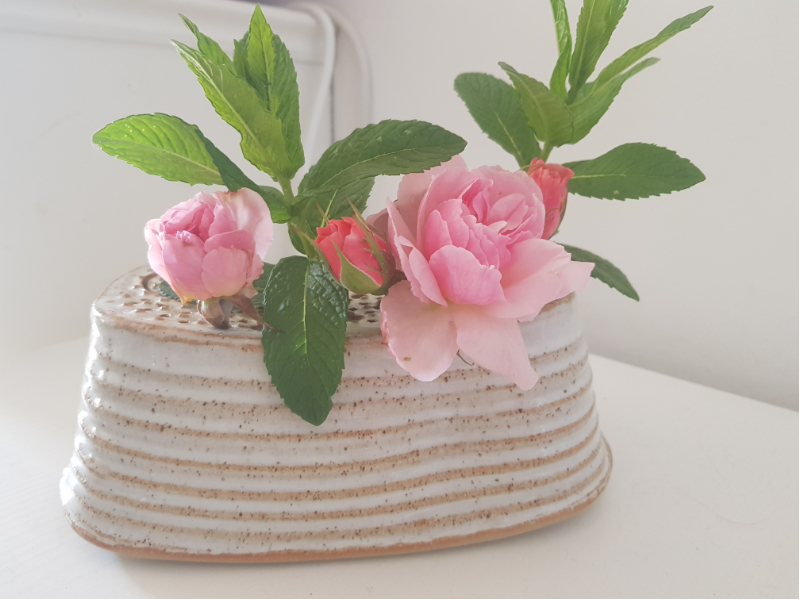
The flowers of wild roses have five petals, five sepals and many stamens, giving the flower its “bushy” look when open. Petal colours may vary from white to yellow to pink to red, in varying shades but all generally have a pleasant, though perhaps subtle, scent.
Wild rose leaves are pinnately compound with serrated margins. Young leaflets are often a light to dark shade of green, whereas older leaves tend to be a very dark green. Leaflets alternate in an odd number ‑ usually five or seven.
Stems are rounded and harbour thorns along the length. Newer growth may not yet appear the have thorns. Some thorns are long and hooked which often help the plant to “climb”.
Rose hips (the fruit) start out green and hard, forming where pollinated flowers once stemmed (if these flower heads were never cut off). They will transform in colour over time, from orange to red, when we finally harvest. The shape of the fruit may vary in size and shape but inside there are many small seeds and a hairy layer which can irritate the throat and mucosa if ingested.
Once established, wild roses are very hardy, overcoming even black spot in the hardier examples, and becoming extremely difficult to kill. That is, if you ever wished to kill one anyway.
Harvesting:
The best medicinal roses are often wild roses. Those without a smell or that were grown with pesticides should be avoided. If you inherit a rose and don’t know whether pesticides were used in the past or not it is, it’s best to avoid harvesting from it for a number of years or avoid altogether.
All wild roses can be used in food and medicine, as long as that they smell pleasant and are grown without pesticides [5]. The waxier petals of cultivated roses are hard to cook with as they toughen rapidly [11] and cultivated roses are, often, grown with pesticides.
Hips are best harvested after the first frost, however, in my experience this can vary so much in the UK that you might miss the opportunity if you wait so long. I prefer to watch the temperatures and the depth of colour of the hip, picking one and trying before picking a larger quantity.
Even if drying or freezing hips for longevity, some processing is recommended before these stages. Rose hips contain small “hairs” that irritate the mouth and stomach lining when ingested; by removing these as soon as the fruit is harvested you avoid the risk of ingesting any of these unintentionally [11].
Rose petals should be dried away from direct sunlight. They should be turned regularly to ensure even drying. I prefer to dry them as I would if collecting seeds, upside down with a paper bag over the flower. This stops any petal loss and can be a good gauge of how well the flower is drying. You will know they are truly dry when you can crumble them between your fingers.
Rose hips are perhaps best dried in a dehydrator due to their higher water content. This should result in a speedier drying time and avoid potential of mould growth whilst you wait.
History and other traditions:
There are records of roses being use in Persia as far back as 500 BC and fossilised roses have been found that are believed to date back 35 million years [13]. Found across the globe, roses often have similar associations and uses found within very different cultures, across generations.
Long associated with love, peace and beauty, many of the rose’s traditional uses and associations are perhaps unsurprising. For example, the Greeks associated the rose with Aphrodite (goddess of love) and her son Eros (god of love), with Romans sharing the same association to their goddess of love, Venus. Far away, the Sufi sect of Islam shared the rose as a symbol of divine love [13].
Medicinal use doesn’t stop at the petals or buds. The fruit (hips) also share a long history of use. In WWII the syrup was recommended by the British government to supplement the diet otherwise lacking in fresh fruits and vegetables [5] [6], providing a much-needed increase in vitamin C. Harvests in the UK were so large, they were even shipped abroad.
Rose hip conserve was given to treat tuberculosis in the Middle Ages [9]. Though not used for such purposes nowadays, you can see how its cooling, anti-inflammatory and astringent properties may provide relief in such a condition.
Medicinal summary:
Roses are perhaps one of the herbs I use most extensively, being that they offer such a variety of benefits, both physically and emotionally. Rose hips are notoriously high in Vitamin C; when fresh, it’s said they contain more, per weight, than an orange [5]. Vitamin C is important for sustaining our immune systems and also for collagen production, bettering the health of our skin, ligaments and tendons. Unlike some other animals, such as cats, our own bodies can’t create vitamin C so we need to maintain a constant supply through our diets, year round. One may consider the use rose hips throughout the year, benefitting from their vitamin C content for support in the depths of winter in particular and utilising their cooling energy in the highest heat of summer.
Thanks to their soothing antidepressant and nervine actions, rose petals make it into many a herbal infusion of mine. With stress rife, they can be a welcome addition at work and home, offering support and love when most needed. Rose supports not only our physical heart, but our emotional heart too, offering it’s soothing effects to those suffering from grief, heartache and other forms of emotional distress.
Rose has been used topically for centuries in one form or another. From rose water to rosehip oil, the benefits rose has to our skin is widely acknowledged but some of it’s wider healing properties may go overlooked by non-herbalists. For example, rose water has long been utilised as beauty product, heavily used even in the mainstream cosmetic industry, but due to it’s astringency it makes for an effective and affordable wound wash. Rosehip oil makes for a fantastic moisturising agent but also helps to lessen scarring.
Constituents:
- Anthocyanins (responsible for astringent flavour and colour [4])
- Bitters
- Fatty acids (profound nutritional role, suppling lipids and Vitamin F [4]) [14]
- Flavanoids, including Quercetin (immunomodulatory activity [4], powerful anti-inflammatories [8] and antioxidant [9])
- Geraniol (strong antiseptic activity, seven times stronger than phenol) [4]
- Glycosides (more easily absorbable due to sugar component [4])
- Minerals (including calcium, magnesium, potassium, beta-carotene, quercetin, tocopherols and lycopene) [5]
- Phenolics (a number demonstrate immunological effects [4])
- Tannins (hip) [9]
- Terpenes
- Vitamin C (hips) [6] [8] [9]
- Volatile oils (petals)
Actions:
Fruit
- Anti-inflammatory [5] [7] [8] [10] [11] [13]
- Antioxidant (of which, ascorbic acid, or vitamin C is one) [12]
- Astringent [1] [10] [11] [13]
- Demulcent [5]
Petals
- Analgesic [15]
- Antidepressant [1]
- Anti-inflammatory [5] [7] [8] [10] [11] [13]
- Antimicrobial [1]
- Astringent [1] [10] [11] [13]
- Cardiac tonic [1]
- Diuretic [8] [11] [13]
- Nervine [12] [13]
- Vulnerary [1]
Energy:
- Constricting [10]
- Cooling (presence of flavonoids and fruit acids [9]) [2] [7] [10] [13]
- Drying [1] [10]
- Slightly warming in TCM due to the volatile oil content [9]
Taste:
- Astringent (fruit and petal) [5] [8] [9] [12]
- Bitter (mild) (petals) [5] [9] [12]
- Sour (fruit) [9]
- Sweet (fruit) [9] [12]
Preparations:
- Baths
- Electuary
- Elixir
- Food
- Glycerite
- Hydrosol/Hydrolat
- Infused honey
- Infused oil
- Infused vinegar
- Infusion
- Oxymel
- Syrup
- Tincture
Recipes:
- Blends well with tulsi for emotional support. I find this particularly beneficial, especially if consumed when work is just starting to get to be a little too much.
- Rose petals, rose hips and hibiscus make for a powerful heart health blend [1].
- Blended with hawthorn and mimosa, rose is used in David Winston’s Grief Formula [2].
- Petals and/or hips combined with hibiscus offer effective cooling drinks in the summer.
- Petals blend well with St. John’s Wort, elder and self-heal as an antiviral formula [12].
- Petals blend well with meadowsweet for a mild pain-easing tea.
Safety:
No known concerns though it is recommended all rose hips are processed before use or very well strained due to the irritation their internal hairs can cause to the body when ingested.
Dosage:
- Tincture: 1:5 (dried) or 1:2 (fresh), 30-40%, 3-5 mL, three times a day [2].
- Infusion: 1g – 2g per cup of boiling water. 5 g – 28 g [2]. Dried petals (1:5, 40% alcohol); 5 drops to 2 ml 3 times a day.
Uses:
Heart
Wild rose is a helpful cardiac tonic [1]; a 2020 in vivo study showed the protective effect of the fruit of the Rosa canina against cardiac and hepato-renal toxicities [17]. They are also beneficial in strengthening capillaries, ensuring strong blood flow throughout the body [8][10][13]. It is believed these benefits come from the dog rose’s antioxidant and anticarcinogenic properties.
Beyond the physical heart, roses offer powerful support for what we might refer to as our emotional heart. Katija Swift of Commonwealth Herbs put forth the visual analogy that as its thorns protect animals from predators, the rose can be utilised to protect us from emotional vulnerability [1]. Rose’s nervine and cooling actions back up its use for emotional distress, be that in times of shock, stress, grief, heartbreak or even profound anxiety [2][5][9]. However, it’s not to be saved just for the worst emotional states we find ourselves in. Rose is an uplifting herb which can bring us back into balance when we feel worn down by the daily grind [1] [8].
Wounds
Due to some powerful astringency, rose can be helpful in the healing of internal and external wounds. Rose water, for example, is beneficial first aid for healing weeping wounds due to its astringent action [1]. This astringent property can also be utilised in tightening lax and/or bleeding gum as well as soothing inflamed mouth ulcers [2] [12].
Due to rose’s cooling nature, a cooled infusion of the rose petals or rose water has been found to help in soothe burns (including sunburn) when applied topically and regularly.
Immunity
During infections, our bodies quickly use up the vitamin C stores we hold [6]. Rosehips are incredibly high in vitamin C which is key to strengthening our immune system [1] [6] [9] [10] [11]. Botanist, Ronald Melville, found that the hips of the Rosa canina contained more vitamin C than in other rose species [6] but all contain high quantities which make rose hips a great addition to our diets year-round.
Matthew Wood notes that the “petals and hips are used for acute inflammatory conditions of the respiratory tract” [9]. This is again in part due to its high vitamin C content but also due to its anti-inflammatory, antioxidant and demulcent properties. Soothing inflamed tissue and adding moisture is beneficial support in fighting off many respiratory conditions, whilst the antioxidants help to fight free radicals that may be causing damage to the affected cells.
Digestion
As with other skin-soothing herbs, roses properties are effective in soothing internal skin, or mucosa. Its astringent quality is incredibly soothing to the digestive system and can ease symptoms of diarrhoea [1] [6] [9] [11] [13]. Whilst rose’s vulnerary action can be carried through the digestive system, helping to heal leaky gut, ulceration, etc [1].
Where I drink tulsi and rose tea most often for its nervine effects in times of stress or anxiety, both herbs have positive results on the digestive system which can be negatively impacted in such periods. This in turn can be a cause of yet more stress. I find this infusion to heal on both planes, pausing what might be an endless cycle, at least for a brief period.
Food
It is now more widely accepted that food itself can be our medicine. What we put into ourselves each day as part of our diet can have great impact on the health of our bodies and minds. By incorporating herbs regularly into our diets as food, we can enjoy their positive effects in a more palatable and potentially more accessible manner.
Rose has long been utilised as a culinary herb, be that infused to make Turkish Delight, or the petals crumbled as a key component of the beautiful spice mix that is Ras el Hanout. Rose water is also a common ingredient in Middle Eastern, Indian and Chinese recipes. Eating rose hips regularly can reduce oxidative stress [5] on the body and so would make a great daily addition.
There are a range of practical ways to incorporate rose into the daily diet, all of which can be made at home:
- Rose hip jam
- Rose hip chutney
- Rose syrup as a glaze
- Rose sugar in baking
- Rose oxymel as a glaze
- Rose sorbet
Skin
Roses have long used within the cosmetic industry for its benefits to the skin [6], most often used in products aimed at mature skin. However, the flowers and upper leaves can be used to make a mild astringent for tightening tissues and inflamed skin problems [8] which can be of great benefit to those undergoing puberty. Rose hydrosol/hydrolat can be used as a mild skin toner due to its astringency. This is also a gentle but moisturising toner and can be used to refresh the skin throughout the day.
Rose’s cooling and anti-inflammatory action support in soothing inflamed skin, be that around the eyes, the face, or the wider body, making it beneficial to almost everybody. I posit that the only reason not to use rose more often comes down to either a dislike of the scent or a dislike of smelling of roses to others.
Arthritis
It is perhaps surprising to realise rose is a herb noted for it’s benefits in those suffering from arthritic conditions, however, it has been used for such purposes for some time. Rose waters, lotions and baths are used to cure arthritis associated heat due to its cooling quality [9].
Rose hips can be incorporated into the daily diet to support in anti-inflammatory action which can help reduce symptoms of a range of chronic disorders, including osteoarthritis and rheumatoid arthritis. Vitamin C is required to produce collagen and can be found in tendons and ligaments, which may explain its successful use for rheumatic pain [6].
One 2019 study posited that “phenolics, terpenoids, galactolipids, carotenoids, fruit acids and fatty oils can be considered responsible for the observed pharmacological and clinical effects” of Rosa canina in osteoarthritis [16].
Hormones
Rose has a hormone-balancing effect on the female reproductive system, helping to regulate periods and lessening premenstrual and menopausal irritability [8].
Matthew Wood tells us rose is also used for “vaginal discharge, menstrual irregularity and yeast infection” [9] which is also backed up by Julie and Mathew Seal [12].
It is also said that rosehips are high in iron. Vitamin C is key to assimilating iron in the body so be coupling the two people who battle anaemia have much to gain from the humble little rose hip [3].
Diabetes
One 2017 study showed the potential for Rosa canina to have a positive impact on diabetes mellitus due to its high phenolic and flavonoid levels, which account for Rosa canina’s antioxidant action [18].
References:
Websites
- Commonwealth Herbs: https://commonwealthherbs.com/rose-herb-of-the-week/
- Rosalee de la Foret: https://www.herbalremediesadvice.org/rose-benefits.html
- The Practical Herbalist: https://thepracticalherbalist.com/advanced-herbalism/rose-pocket-herbal/
Books
4. Hoffman, D.,2003. Medical Herbalism. Rochester: Healing Arts Press.
5. De la Foret, R. and Han, E., 2020. Wild Remedies. USA: Hay House.
6. Simmonds, M., Hoews, M-J. and Irving, J., 2016. The Gardener’s Companion to Medicinal Plants: An A-Z of Healing Plants and Home Remedies. London: Frances Lincoln Ltd.
7. Codekas, C., 2018. Healing Herbal Infusions. Salem: Page Street Publishing.
8. Chown, V. and Walker, K., 2017. The Handmade Apothecary. London: Kyle Books.
9. Wood, M., 2008. The Earthwise Herbal: Volume 1. Berkeley: North Atlantic Books.
10. Easley, T. and Horne, S., 2016. The Modern Herbal Dispensatory. Berkeley: North Atlantic Books.
11. Fowler, A., 2019. A Modern Herbal. London: Michael Joseph.
12. Rose, N., 2019. The Prisoner’s Herbal. London: Active Distribution
13. Richardson, N. 2020. Your Period Handbook: Natural Solutions for Stress Free Menstruation. London: Aeon Press
14. Grieve, M., 1931. A Modern Herbal: Volume 2. Dover Publications Inc.
Journals/articles
15. Casetti F, Wölfle U, Gehring W, Schempp CM. Dermocosmetics for dry skin: a new role for botanical extracts. Skin Pharmacol Physiol. 2011;24(6):289-93. doi: 10.1159/000329214. Epub 2011 Jun 25. PMID: 21709432.
16. Kulaitienė J, Medveckienė B, Levickienė D, Vaitkevičienė N, Makarevičienė V, Jarienė E. Changes in Fatty Acids Content in Organic Rosehip (Rosa spp.) Seeds during Ripening. Plants (Basel). 2020 Dec 17;9(12):1793. doi: 10.3390/plants9121793. PMID: 33348824; PMCID: PMC7766681.
17. Cheng BC, Fu XQ, Guo H, Li T, Wu ZZ, Chan K, Yu ZL. The genus Rosa and arthritis: Overview on pharmacological perspectives. Pharmacol Res. 2016 Dec;114:219-234. doi: 10.1016/j.phrs.2016.10.029. Epub 2016 Nov 2. PMID: 27816506.
18. Gruenwald J, Uebelhack R, Moré MI. Rosa canina – Rose hip pharmacological ingredients and molecular mechanics counteracting osteoarthritis – A systematic review. Phytomedicine. 2019 Jul;60:152958. doi: 10.1016/j.phymed.2019.152958. Epub 2019 May 12. PMID: 31138475.
19. Fetni S, Bertella N, Ouahab A. LC-DAD/ESI-MS/MS characterization of phenolic constituents in Rosa canina L. and its protective effect in cells. Biomed Chromatogr. 2020 Dec;34(12):e4961. doi: 10.1002/bmc.4961. Epub 2020 Aug 14. PMID: 32737906.
20. Jemaa HB, Jemia AB, Khlifi S, Ahmed HB, Slama FB, Benzarti A, Elati J, Aouidet A. ANTIOXIDANT ACTIVITY AND A-AMYLASE INHIBITORY POTENTIAL OF ROSA CANINA L. Afr J Tradit Complement Altern Med. 2017 Jan 13;14(2):1-8. doi: 10.21010/ajtcam.v14i2.1. PMID: 28573216; PMCID: PMC5446433.
 Herbal She Wrote
Leave a comment