

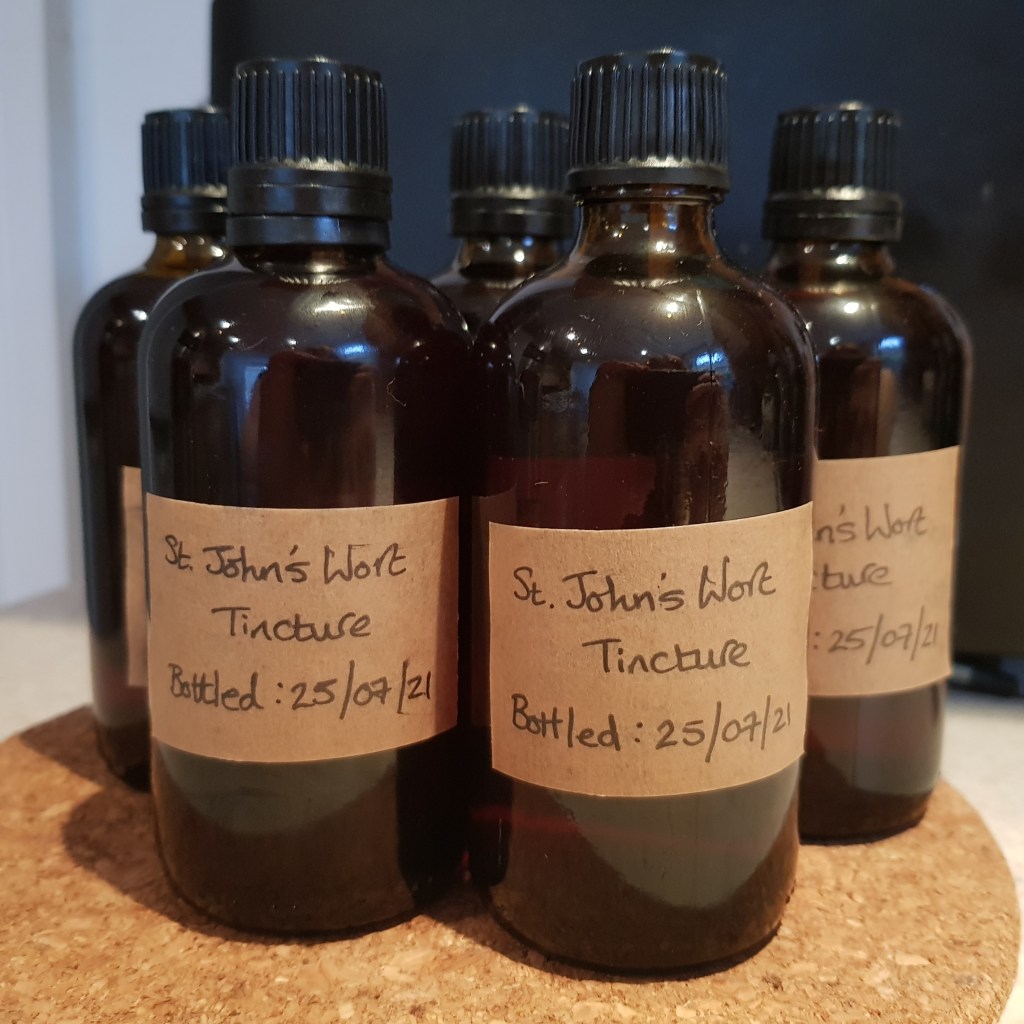
After coming back from a mini break far from London (the excitement to leave for the first time in 18 months was insane) my first batch of St. John’s Wort oil and tincture were ready for bottling. The second batch should be ready in a week or so.
Though a small batch of oil, this year it actually came out that iconic ruby-red colour we all know and love from St. John’s Wort oil. Last year I was too scared to give it the time in the sun it really needs and the result was a murky brown – still useful, though marginally so. After some further research to allay my fears, this year I embraced any sun we had here in England and it feels as though I have been rewarded well.
St. John’s Wort oil
Due to the many benefits of SJW, it was the first oil I ever felt inspired to make myself so it feels good to finally have a version I can use and feel the benefits from. Many herbalists out there mention it as a staple to have on the shelf and you can certainly see why.
The nervine effects of SJW have been greatly researched in relation to use with depression but it can also be used topically to help relieve tension and pain in the physical body.
Considered the go-to herb for nerve pain, SJW oil can be of great benefit in conditions such as sciatica, shingles, nerve trauma, pinched nerves, etc. As a powerful antiviral also, this combination can be particularly suited to those suffering from viruses that affect the nerves.
SJWs antispasmodic action makes it a fantastic muscle rub, either as a massage oil or as a liniment. Not only useful for sports-related muscle pain, SJW oil can be used in instances of “growing pains” as well as in cases of painful stomach cramps when menstruating.
As a vulnerary and anti-inflammatory, the oil can also help in wound repair.
St. John’s Wort tincture
As for my tincture, I had a fairly large batch for me – 500 ml. Let’s see if this will take me through until next year’s solstice when it is time to harvest once again.
Taken internally, SJW can boost the actions sought externally with use of the oil, but it also has additional benefits to offer.
SJW tincture and tea can be used to help in cases of mild to moderate depression as well as seasonal affective disorders (which I find particularly beneficial when used in combination with lemon balm glycerite).
The tincture itself can also be applied topically to cold sores and shingles to help provide relief. As someone who suffered from shingles as a child, I would suggest applying the oil after the tincture in this case as the blisters that come from the virus are already extremely painful and itchy and I can’t see the drying nature of alcohol as found in tinctures helping these symptoms at all.
SJW is considered a tonic to the liver (just look at how quickly it can cause prescription medication to be metabolised) and can help in a number of processes surrounding digestion and removal of waste. It can help with processing insulin in our sugar-rich diets, increases bile production, can help rebalance issues with the digestive tract that can cause diarrhoea and works as a diuretic – increasing waste removal.
In addition, with its antiviral and anti-inflammatory actions, SJW can be a helpful addition in support of the immune and respiratory systems.
Basic St. John’s Wort oil method
- Pick flowers in the morning and allow them to wilt for several hours (precisely how many hours are needed will depend on your location and the climate). The aim is to remove the majority of the water from the flowers, whilst retaining a high quality herb. In England I found that picking in the morning before work and leaving to sit until after work eight hours later worked well. Some methodologies tell you to harvest by chopping the top aerial parts but I find that by picking individual flowers I can harvest for a far longer period than I could otherwise and I can save the young leaves for drying. You will want to fill your jar 3/4 of the way so bear this in mind when harvesting (this is why I make batches in smaller jars but more of them throughout the season).
- Put your wilted flowers into a jar with a tight-fitting lid and pour over your carrier oil of choice. I used organic olive oil in this case due to accessibility and the quantity I would need but jojoba is another of my go-tos as it is so amazing on the skin. You need to really fill the container to avoid mould growth at the top.
- Cap your jar and gently agitate daily for 6 weeks. Don’t worry if you do miss a day here and there but make sure it is the exception, not the rule. Putting a daily reminder alarm on your phone might be helpful.
- Unlike most herbal oils, SJW oil is one that greatly benefits from exposure to the sun so place on a sunny windowsill (or alternative) on top of a saucer or small plate for the duration. This is what causes the oil to turn the iconic ruby-red colour which is considered a sign of the hypericin having been extracted.
Basic St. John’s Wort tincture tips
- Pick flowers in the morning and allow them to wilt for several hours (precisely how many hours are needed will depend on your location and the climate). The aim is to remove the majority of the water from the flowers, whilst retaining a high quality herb. In England I found that picking in the morning before work and leaving to sit until after work eight hours later worked well. Some methodologies tell you to harvest by chopping the top aerial parts but I find that by picking individual flowers I can harvest for a far longer period than I could otherwise and I can save the young leaves for drying. You will want to fill your jar 3/4 of the way so bear this in mind when harvesting (this is why I make batches in smaller jars but more of them throughout the season).
- Put your wilted flowers into a jar with a tight-fitting lid and pour over 40% vodka. In the UK, you’re hard pushed to find higher percentage; this is why wilting the fresh flowers first is so important.
- Cap your jar and gently agitate daily for 4 weeks. Don’t worry if you do miss a day here and there but make sure it is the exception, not the rule. Putting a daily reminder alarm on your phone might be helpful.
- Store in the dark for the maceration period. You’ll notice that the tincture starts to turn red almost straight away in case of tinctures but it continues to develop over the four weeks.
 Herbal She Wrote
Leave a comment