Binomial
Schisandra chinensis
Common name:
Five flavour fruit, Schisandra, Magnolia vine, Bei-Wuweizi, Wu Wei Zi [3], gomishi (in Japan), amika (in Korea), ng may gee (in Hong Kong) [13]
Family:
Magnoliaceae/Schisandraceae
Parts used:
Berries
Native to:
China and Eastern Russia
Distribution:
Northeast Asia, Eastern Russia, Japan, Korea
Botanical Description:
Deciduous or evergreen woody vine that grows upwards of 20ft.
Simple ovate to lanceolate leaves are alternate on slender stalks.
Solitary or clustered blooms flowers in April/May. Sepals and petals are indistinguishable. Carpals are densely packed in female flowers, elongating as they ripen. Final carpals form a spike several centimetres long.
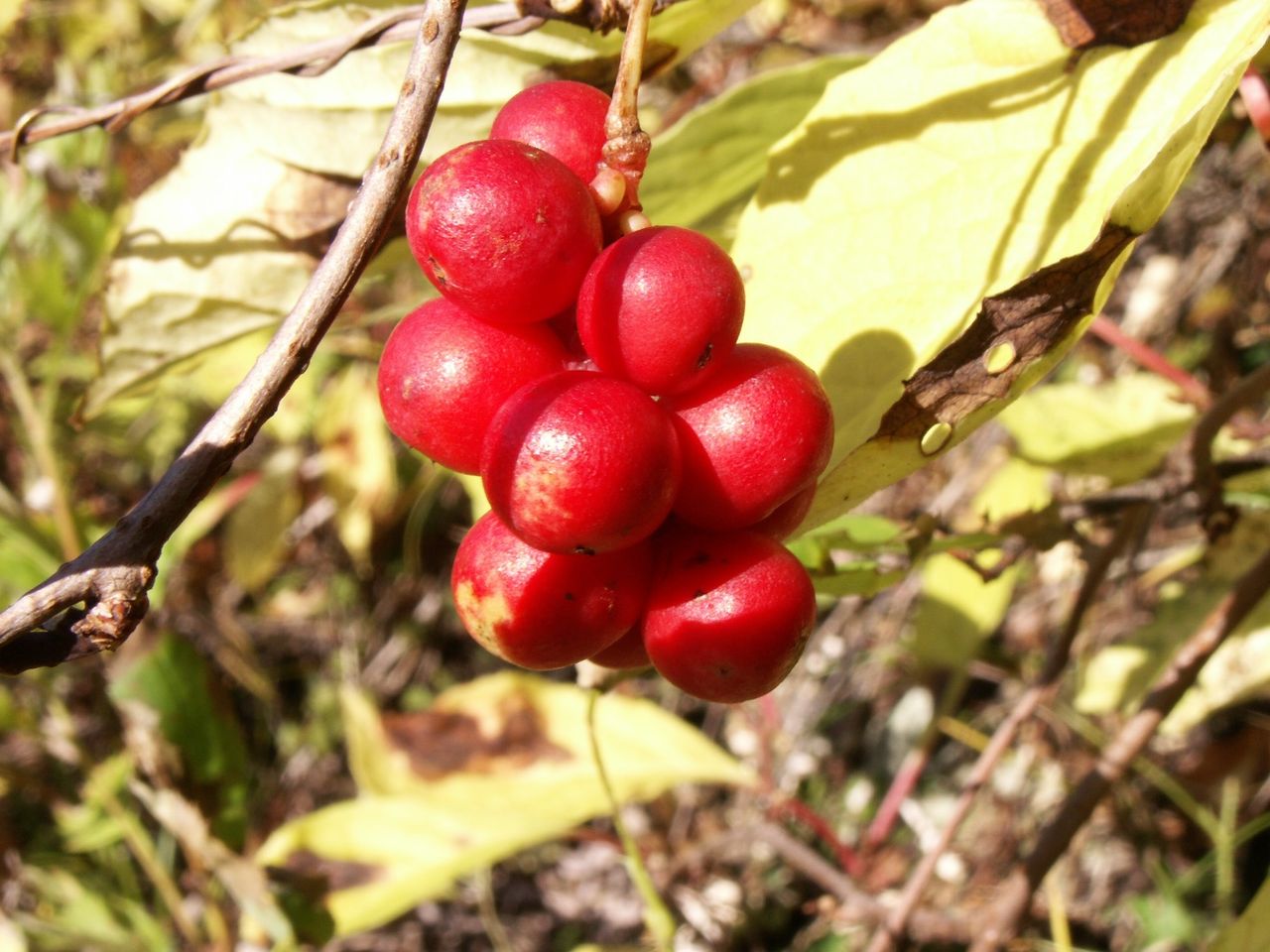
Red fruit develops in autumn.
Schisandra is very cold hardy as long as they’re able to go dormant in autumn. The cold is required for the fruit to set.
Protect from direct sunlight and keep well-watered in well-draining, acidic soil.
Harvesting:
Generally not wildcrafted, especially not in the UK. Harvested in autumn whilst red and dried under the sun.
History and other traditions:
Schisandra chinensis has been utilised for centuries in Traditional Chinese Medicine (TCM) and more recently in Western traditions. Its value was considered so high that in the late sixteenth century officials in Hezhong prefecture sent large quantities to the Emperor as tribute [13].
The berries are noted for their powerful effect on the whole body. Due to their encompassing all five tastes (sweet, sour, pungent, bitter and salty) they are believed to associate to each of the five yin organs (Liver, Spleen, Lung, Heart and Kidney), offering whole body support. The berries are also considered to nourish a person’s jing energy (our deep foundational energy reserves, synonymous with vitality) [13].
Besides it’s medical applications, Schisandra has a long use more spiritually. Known as the “peacemaker”, it is often used as a tea by Buddhist monks due to its ability to calms the mind in preparation for meditation [13].
Medicinal summary:
S. chinensis is a gentle whole body adaptogen with a myriad of actions, supportive in many and ranging health concerns. So many so that it feels we can only skim the surface here.
Perhaps one of its most notable uses is due to its ability to support the hypothalamus-pituitary-adrenal (HPA) axis, resulting in a fascinating dual effect on the nervous system. Whilst enhancing focus, work performance and mental clarity it also provides calming and relief for mild anxiety. It is even being viewed for the potential in helping in Alzheimer’s disease (Seoul University) [13].
In TCM, it has long use both in drying up excess moisture (i.e. mucous, night sweats and frequent urination) and in stimulating labour in later pregnancy.
It’s a restorative, a qi tonic, often used for those chronically drained and requiring convalescence.
Schisandra is also turned to by the sleepless, those experiencing anxiety and even mild depression, with researchers believing it is involved in the serotonergic, noradrenergic, dopaminergic, GABAergic and glutamatergic systems [21]. With its ability to calm chronic stress and help in stress-related symptoms, Schisandra is perhaps one of our greatest modern plant allies.
An immune amphoteric and immune modulator, schisandra works to protect the brain, skin, liver, cardiovascular and wider organ systems. Its combined ability to reduce the histamine response and act as an astringent in the mucous membranes (a property which lends further positive effect in cases of diarrhoea), means it can be of great help during seasonal allergies.
Schisandra appears to have a special affinity for the liver, acting as a liver tonic and rejuvenator, especially in cases where the liver receives damage.
It further strengthens the lungs in more chronic conditions such as asthma, though should be avoided in more acute conditions.
Constituents:
- Beta-carotene [3]
- Chromium
- Citric acid [1], [3]
- Dibenzocyclo-octane lignans (schisandrins, schizabdrois, schisantherins, gomisins) [1], [3], [12]
- Fumaric acid
- Magnesium
- Malic acid [1], [3]
- Niacin [3]
- Nigranoic acid [3]
- Pectins [3]
- Phosphorous
- Potassium
- Quercetin
- Resins [3]
- Sterols [3]
- Tannins [3]
- Tartaric acid [1], [3]
- Trace minerals [1], [3]
- Triterpenes [1], [4]
- Vitamins A, C and E [3]
Actions:
- Adaptogen [3], [6], [8], [9], [10], [11], [13]
- Amphoteric [13]
- Anti-asthmatic [13], [17], [18]
- Antibacterial [13]
- Antidiabetic [3]
- Anti-inflammatory [11], [13], [17], [13]
- Antioxidant [3], [10], [11]
- Antiseptic
- Antitussive [3], [9]
- Antiviral
- Astringent [11], [13]
- Bitter [4], [10], [11]
- Cardioprotective [3], [13]
- Expectorant [13]
- Hepatoprotective [3], [9], [11], [13]
- Immune amphoteric [9], [11], [12], [13],
- Liver tonic [3], [4], [6], [10], [13]
- Lung tonic [9]
- Nervine tonic [3], [10], [11], [13]
- Neuroprotective [3], [6]
- Nootropic [3], [11]
- Renal tonic [3]
- Uterine tonic [3]
Energy:
- Cooling [9]
- Diffusive [1]
- Drying [11], [13]
- Moistening [9]
- Warming [1], [11]
Taste:
- Bitter
- Pungent
- Sweet
- Sour
- Salty
Preparations:
- Decoction
- Fluid extract
- Infusion
- Syrup
- Vinegars
- Water
Recipes:
- Combines with Rhodiola rosea and Eleutherococcus senticosus for pneumonia [3] and improving cognitive function in women who report feeling stressed over long periods of time [22].
- Combine with Rosa spp. and honey in tea in those who have a warm constitution [1].
- With Ginseng and liquorice, helps the kidneys “grasp the lung qi”, aiding respiratory conditions [13]
- Can be combined with Eleutherococcus to enhance athletic performance [13]
- Helpful along with Bacoba, oats and Rhodiola for ADHD.
Safety:
- Generally considered safe, as a food herb, for long-term use [13].
- May be too warming for those running hot.
- Large quantities may cause digestive issues [11].
- May interfere with opiates (acetaminophen, hydrocodone and morphine) and Warfarin [1], [11].
- May increase the effects of barbituates [13]
- May increase the metabolism of oestrogens [3].
- May increase uterine contractions. Avoid in pregnancy and breastfeeding, though can be useful to help the uterus contract after labour [1], [3].
- Contraindicated with acute ailments like colds, flu and fevers [9].
- Overuse can lead to insomnia and anxiety [9].
Dose:
Decoction: 4 oz 3x/day [9].
Dried berries: 10 berries once daily [9].
Infusion: 4 oz – 8 oz 3x/day [9].
Tincture: 1 ml – 3 ml (1:3, 40%) 3x/day [9].
2 ml – 4ml (1:5) 3 or 4x/day [13].
Uses:
Cardiovascular and venous
Schisandra is known to have beneficial effects on the cardiovascular system. This is believed to be due, at least in part, to its lignan content. From normalising blood pressure [13] to improving circulation [9], [11], Schisandra may also have impact on cardiovascular disease and improve cardiac function after heart attacks.
Digestive system
With bitter constituents, Schisandra can be beneficial in stimulating the digestive processes and can be a welcome addition to a digestive bitter’s formula [9].
It’s also been used effectively in both cases of diarrhoea [13] and constipation.
Emotional stress
A credited adaptogen [6], [8], [9], Schisandra is safe to take long-termto help provide support in stress-induced conditions [13]. This is often credited to its ability to modulate stress hormones (adrenaline, noradrenaline and cortisol) [6], [13].
It also has the powerful ability to reduce fatigue, improve focus, clarity and coordination [13], and increase endurance [3], [10], [11], [13], as well as offering a positive effect on sleep [13], perhaps due to its calming [13] energy.
Hepatoprotective
Schisandra appears to have a special affinity with the liver, particularly where damage or injury has already been caused. It increases hepatic glutathione (essential liver antioxidant) [13], allowing potential benefit in a range of liver conditions.
At its base level it detoxifies the liver [1], [8], but it has been found to be effective in some cases of hepatitis recovery, chronic liver disease and liver infections [4], [13] as well as improving liver function in fatty liver disease [16].
Hormones
Schisandra has the ability the maintain hormonal balance (especially sex hormones and stress hormones like cortisol), as well as providing adrenal support [7], [13].
It’s been found to be of particular benefit to menopausal and postmen postmenopausal women [15], [13], increasing calcium uptake and helping prevent osteoarthritis [3], [14] as wll as helping to ease hot flushes [15].
Focusing more on the reproductive system, Schisandra has some use in toning the sexual organs of both men and women [13], and shows promise in animal testing for enhancing function of the ovaries in studies on mice [13].
Immune system
Schisandra offers antioxidant activity across the cardiac, immune and lymphatic systems. As a nourishing [13] tonic adaptogen, it can be taken daily, providing ongoing support to these systems.
Miscellaneous
There are several conditions S. chinensis has and is being used for across the herbal community with minimal to no supporting scientific research. However, clinical practice suggests powerful potential in conditions such as ADHD [6], arthritis and rheumatoid arthritis [13] and even as a protective measure against free-radical induced tissue injury within the brain [6].
Research has been conducted which has found Schisandra to have Chemoprotective, radioprotective [13] and antitumour properties [13].
Schisandra helps “Control urinary frequency” by supporting kidney and urinary functions [13] as well as providing positive support in connective tissue diseases [13].
Nervous system
As an adaptogen, Schisandra has positive effects in cases of anxiety and mild depression [7], [8]. Some believe this is due to its ability to increases dopamine, one of our key neurotransmitters.
Whilst it stimulates the central nervous system [9], Schisandra is known to relax the mind and induce restful sleep and so can be beneficial for those suffering insomnia or other sleep conditions.
Physical stress
A key requirement that defines an adaptogen is to “help you respond to any influence or stressor, normalizing your physiological functions”. This being said, Schisandra is beneficial support for those undergoing physical stress as well as emotional with its ability to increase endurance by increasing oxygenation to the body and reduce nitrous oxide accumulation after exercise [13].
Respiratory system
Schisandra has long been used in TCM to revitalise the respiratory system [9], leading to its use as an anti-asthmatic herb asthma, a practice which has more recently been replicated in Western Herbalism [13].
Acting as a gentle expectorant, it can also be beneficial in chronic respiratory conditions such as coughing [13] and wheezing but should be avoided in more acute conditions. For such conditions it is commonly used in conjunction with other respiratory herbs
Skin
Research suggests that S. chinensis helps protect against skin photoaging [3] as well as helping to inhibit allergy-induced skin conditions (such as hives and eczema) and can even inhibit excessive sweating [13] due to its astringent property.
References:
Websites
- The Herbarium: https://herbarium.theherbalacademy.com/monographs/#/monograph/4066
- Herbs with Rosalee: https://www.herbalremediesadvice.org/schisandra-benefits.html
Books
- Thomsen, M., 2022. The Phytotherapy Desk Reference. 6th Edition. Aeon Books: London.
- Ganora, L., 2021. Herbal Constituents: Foundations of Phytochemistry. 2nd Edition. Herbal Chem Press: USA.
- Stansbury, J., 2018. Herbal Formulas for Health Professionals Volume 1: Digestion and Elimination. Chelsea Green: USA.
- Stansbury, J., 2020. Herbal Formulas for Health Professionals Volume 2: Neurology, Psychiatry and Pain Management. Chelsea Green: USA.
- Stansbury, J., 2020. Herbal Formulas for Health Professionals Volume 5: Immunology, Orthopedics and Otolaryngology. Chelsea Green: USA.
- Bone, K., 2021. Functional Herbal Therapy: A Modern Paradign for Clinicians. Aeon Books: London.
- Easley, T. and Horne, S., 2016. The Modern Herbal Dispensatory. North Atlantic Books: USA.
- Chown, V. and Walker, K., 2017. The Handmade Apothecary: Healing Herbal Remedies. Kyle Books: London.
- Langelier, K., 2020. Herbal Revolution. Page Street Publishing Co: USA.
- Hoffman, D., 2003. Medical Herbalism: The Science and Practice of Herbal Medicine. Healing Arts Press: USA.
- Winston, D., 2019 , Adaptogens: Herbs for Strength, Stamina and Stress Relief. Updated. Healing Arts Press: USA.
Journals/articles
- Todorova V, Ivanov K, Delattre C, Nalbantova V, Karcheva-Bahchevanska D, Ivanova S. Plant Adaptogens-History and Future Perspectives. In: Nutrients. 2021 Aug 20;13(8):2861. doi: 10.3390/nu13082861. PMID: 34445021; PMCID: PMC8398443.
- Cho YH, Lee SY, Lee CH, Park JH, So YS. Effect of Schisandra chinensis Baillon extracts and regular low-intensity exercise on muscle strength and mass in older adults: a randomized, double-blind, placebo-controlled trial. In: Am J Clin Nutr. 2021 Jun 1;113(6):1440-1446. doi: 10.1093/ajcn/nqaa447. PMID: 33710261.
- Park JY, Kim KH. A randomized, double-blind, placebo-controlled trial of Schisandra chinensis for menopausal symptoms. In: Climacteric. 2016 Dec;19(6):574-580. doi: 10.1080/13697137.2016.1238453. Epub 2016 Oct 20. PMID: 27763802.
- Chiu HF, Chen TY, Tzeng YT, Wang CK. Improvement of liver function in humans using a mixture of schisandra fruit extract and sesamin. In: Phytother Res. 2013 Mar;27(3):368-73. doi: 10.1002/ptr.4702. Epub 2012 May 21. PMID: 22610748.
- Li B, Xiao Q, Liu J, Mu X, Zhang J, Qi Y, Zhang B, Xiao P, Liu H. Chemical Characterization and Potential Mechanism of the Anti-Asthmatic Activity of a Subfraction from Schisandra chinensis Fruit Extract. In: J Agric Food Chem. 2022 Apr 27;70(16):5015-5025. doi: 10.1021/acs.jafc.2c01034. Epub 2022 Apr 13. PMID: 35416657.
- Lin CC, Xu ZY, Wang BH, Zhuang WY, Sun JH, Li H, Chen JG, Wang CM. Relaxation Effect of Schisandra Chinensis Lignans on the Isolated Tracheal Smooth Muscle in Rats and Its Mechanism. In: J Med Food. 2021 Aug;24(8):825-832. doi: 10.1089/jmf.2021.K.0037. PMID: 34406878; PMCID: PMC8403203.
- Kopustinskiene DM, Bernatoniene J. Antioxidant Effects of Schisandra chinensis Fruits and Their Active Constituents. In: Antioxidants (Basel). 2021 Apr 18;10(4):620. doi: 10.3390/antiox10040620. PMID: 33919588; PMCID: PMC8073495.
- Yan T, Xu M, Wu B, Liao Z, Liu Z, Zhao X, Bi K, Jia Y. The effect of Schisandra chinensis extracts on depression by noradrenergic, dopaminergic, GABAergic and glutamatergic systems in the forced swim test in mice. In: Food Funct. 2016 Jun 15;7(6):2811-9. doi: 10.1039/c6fo00328a. Epub 2016 May 26. PMID: 27225351.
- Aslanyan, G, E Amroyan, E Gabrielyan, M Nylander, G Wikman, and A Panossian. Double-blind, Placebo-controlled, Randomised Study of Single Dose Effects of ADAPT-232 on Cognitive Functions. In: Phytomedicine : international journal of phytotherapy and phytopharmacology 17, no. 7 (2010): doi:10.1016/j.phymed.2010.02.005.
 Herbal She Wrote
Leave a comment