
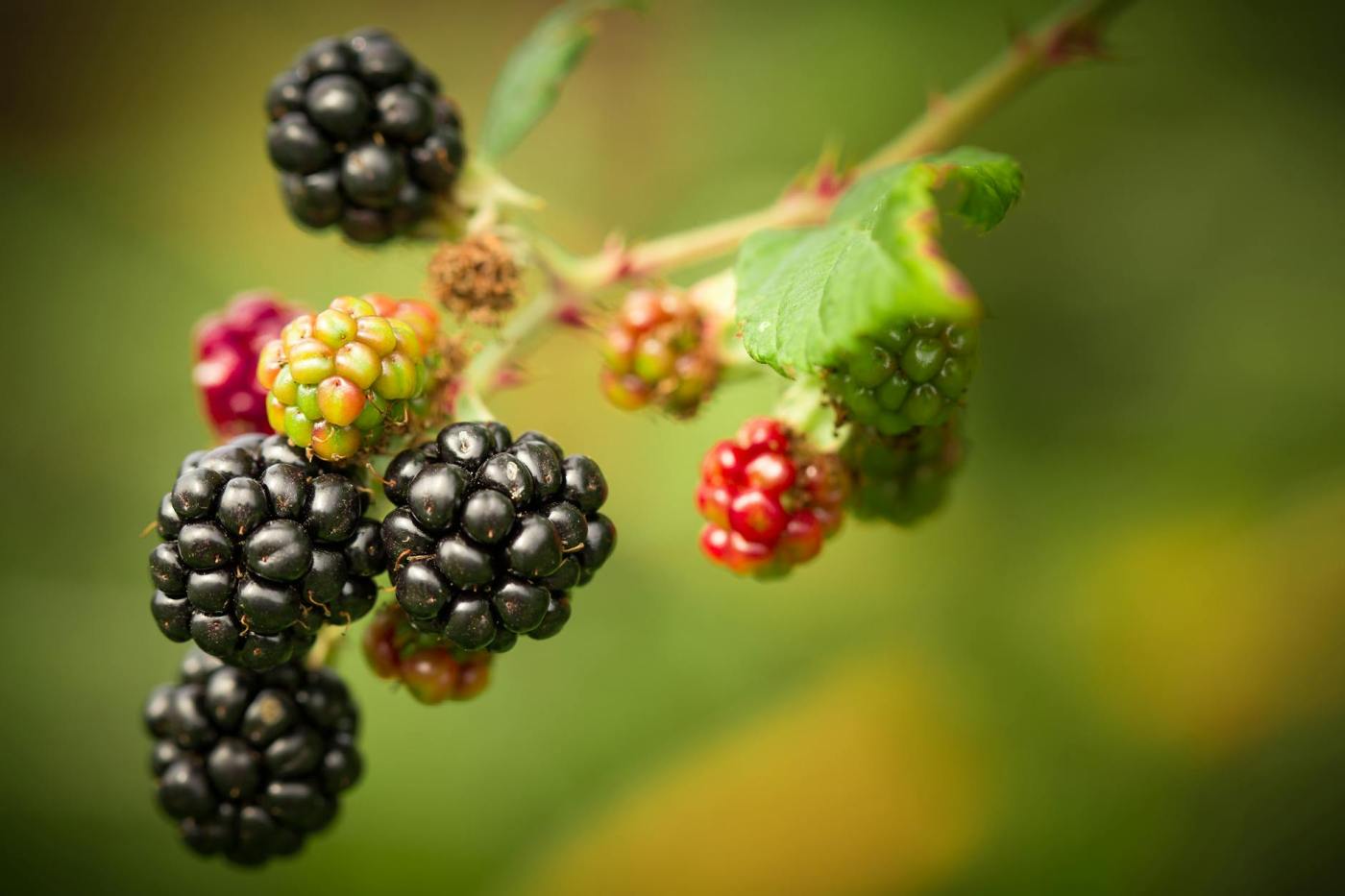
It’s not often I write something that I’m even a little proud of, but this week we were given the task to write a brief profile on a local plant, with a focus on it’s folklore and I wrote my favourite sentence I’ve ever written so I thought I’d share it here.
Blackberry/Bramble – Rubus fruticosus
Perhaps only one thing can lay claim to being the true thorn in Lucifer’s…butt, and that’s the humble bramble, blackberry or Rubus fruticosus. It’s said that on September 29th, now the holiday known as Michaelmas, Archangel Michael succeeded in banishing Lucifer from heaven. Upon his, presumably, hard fall from grace, Lucifer landed in hell, right on top of a thorny blackberry bush. Understandably angry, he then proceeded to spit, stomp, or even urinate on the bush, depending on who is telling the tale. It is for this reason that, for centuries, people have been warned never to eat blackberries after September 29th. In modern times, this advice has been supported, with evidence of a dangerous fungus often present on the blackberry bush from early autumn.
With such an origin story, it’s perhaps surprising that some also considered blackberries to be the “fruit of the devil”, backed up by the belief that her thorns were included in Christ’s very own punishing crown of thorns. The contradictions surrounding blackberry continue, with bushes having been planted on top of graves to prevent the dead from rising and walking the land, to being used both in many a healing magical charm and also used to protect against “evil runes”.
Blackberry’s healing potential, however, doesn’t seem to have come into question too much, regardless of any negative Christian associations. One of the oldest rituals associated with the blackberry bush is that of crawling through its revered arches a number of times, from east to west, to cure what ails you. This same ritual is also said to bring you luck in card games…providing you’re willing to earn these gains through a pact with the devil. Whereas, along the Welsh border others would leave a slice of bread as an offering to the blackberry; when it was invariably eaten by an unsuspecting creature, their ailment would be taken along with it.
In the realms of magic, the bramble’s thorns are considered potent for use in protection spells, used in the past for binding and containing energy. Her leaves and berries lend their use to wealth magic, whereas drunk as a tea she’s said to enhance the qualities of persistence and patience in both love and spiritual endeavours. Sacred to several ancient Pagan deities, such as Brigit, and associated with the softer, more feminine aspects of Venus and Water, I find blackberry to be quite enigmatic.
Much like others in the Rosaceae family, then, it seems she has the flexible capacity to be both gentle and strong, yielding and rigid, sweet and sour, depending what she is called forth to do. A “friend” to the poor, a food source spanning back at least to neolithic times, and still beloved by even amateur foragers to this day, I like to imagine the humble blackberry like a village wise-woman of old, there for all in their time of need, offering a shoulder to cry on, a clip round the ear, or spurring you on through the hardest of challenges.
References
Albright, M. B. (2015). Michaelmas: The Day the Devil Spit on Your Blackberries. https://www.nationalgeographic.com/culture/article/michaelmas-the-day-the-devil-spit-on-your-blackberries
BBC. (n.d.). 8 juicy facts about blackberries and brambles. https://www.bbc.co.uk/programmes/articles/3FlYJMmMnMtHXWsDMVtK8SB/8-juicy-facts-about-blackberries-and-brambles
Cunningham, S. (2003). Encyclopaedia of magical Herbs. Llewellyn Publications.
Grieve, M. (1931). A Modern Herbal: Volume 1. Dover Publications Inc.
Harford, R. (2019). Edible and Medicinal Wild Plants of Britain and Ireland. Eatweeds.
Kindred, G. (2006). Herbal Healers. Wooden Books Ltd.
Lawrence, S. (2020). Witch’s Garden: Plants in Folklore, Magic and Traditional Medicin. Welbeck Publishing Group.
 Herbal She Wrote
Leave a comment